Overhead cranes and EOT (Electric Overhead Travelling) cranes form the mainstay of manufacturing plants, steel industries, cement plants, and fabrication yards all over India. However, no matter how robust the crane may be, its efficiency and reliability ultimately depend on the manner in which it is operated and controlled. It is at this point that the controversy between wireless crane remote control and pendant crane control assumes significance for plant owners, safety officers, and procurement managers.
While both these methods have been in use for many years now, there is an increasing tendency towards adopting the wireless technology in view of higher safety norms and automation requirements. In this blog post, we shall compare and contrast the two approaches, their pros and cons, and discuss some other factors that need consideration in order to arrive at a suitable choice — not forgetting the equally crucial but less talked about aspect of bimetallic cable lugs.
What Is Pendant Crane Control?
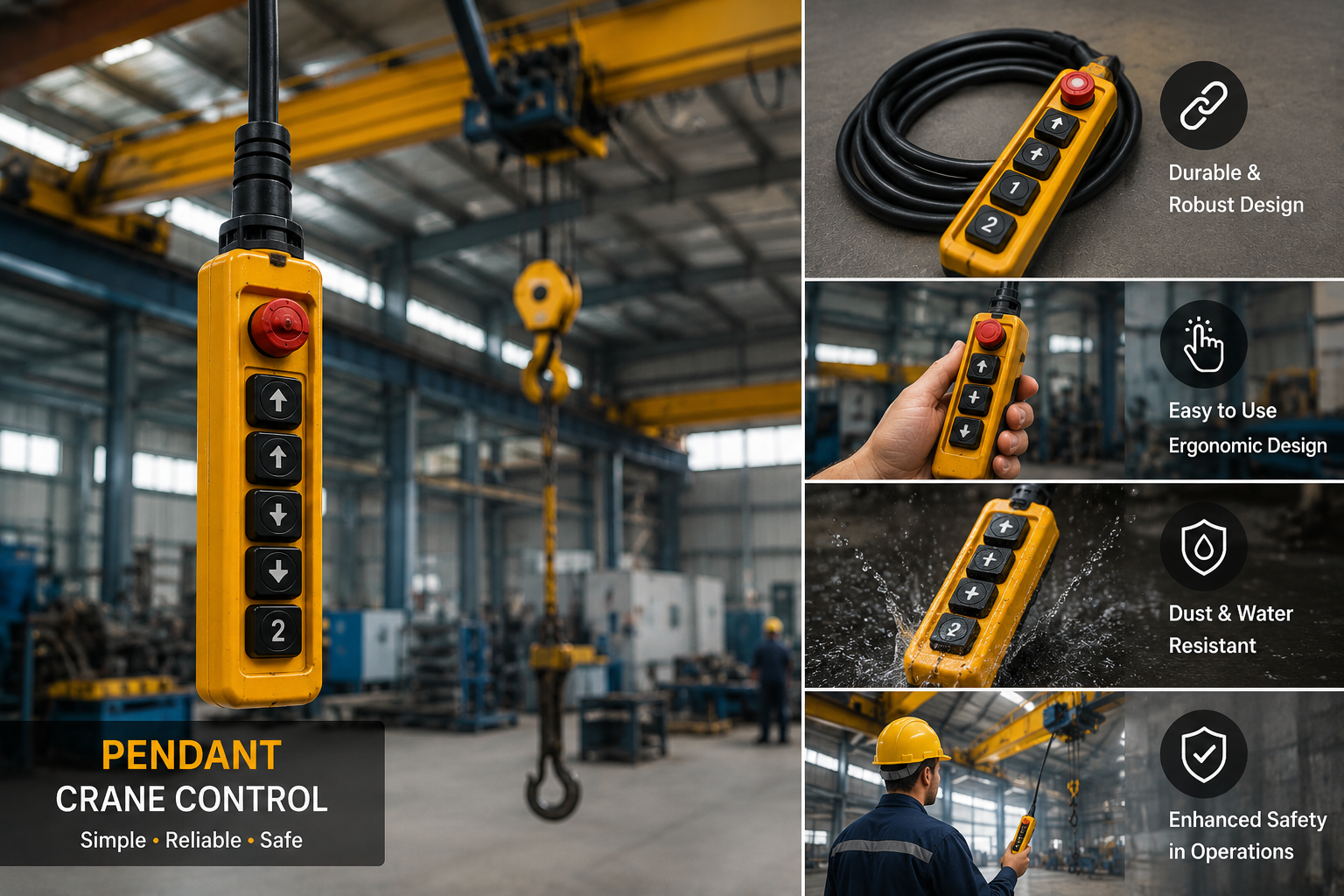
The pendant control system consists of an electronic push button station that is suspended from the crane using a cable. The operator works on the ground floor or from a platform while controlling the movements of the crane through the use of buttons on the pendant – upward, downward, to the left or to the right.
Pendant systems have been the preferred choice for many years because of simplicity and low costs. Nonetheless, there are certain restrictions associated with the system because of the cable used to link the pendant to the crane.
Advantages of Pendant Control
- Lower initial cost than the wireless systems
- Simpler technology with fewer opportunities for signal interference
- Troubleshooting is easy because the connections are visible
- No batteries or charging needed
Limitations of Pendant Control
- Movement limitations for operators because of cable lengths
- Wear and tear of cables as a result of movement
- Safety problems since operators have to position themselves very near loads or the crane
- Decreased visibility in cases where operators are unable to move to a better location
What Is Wireless Crane Remote Control?
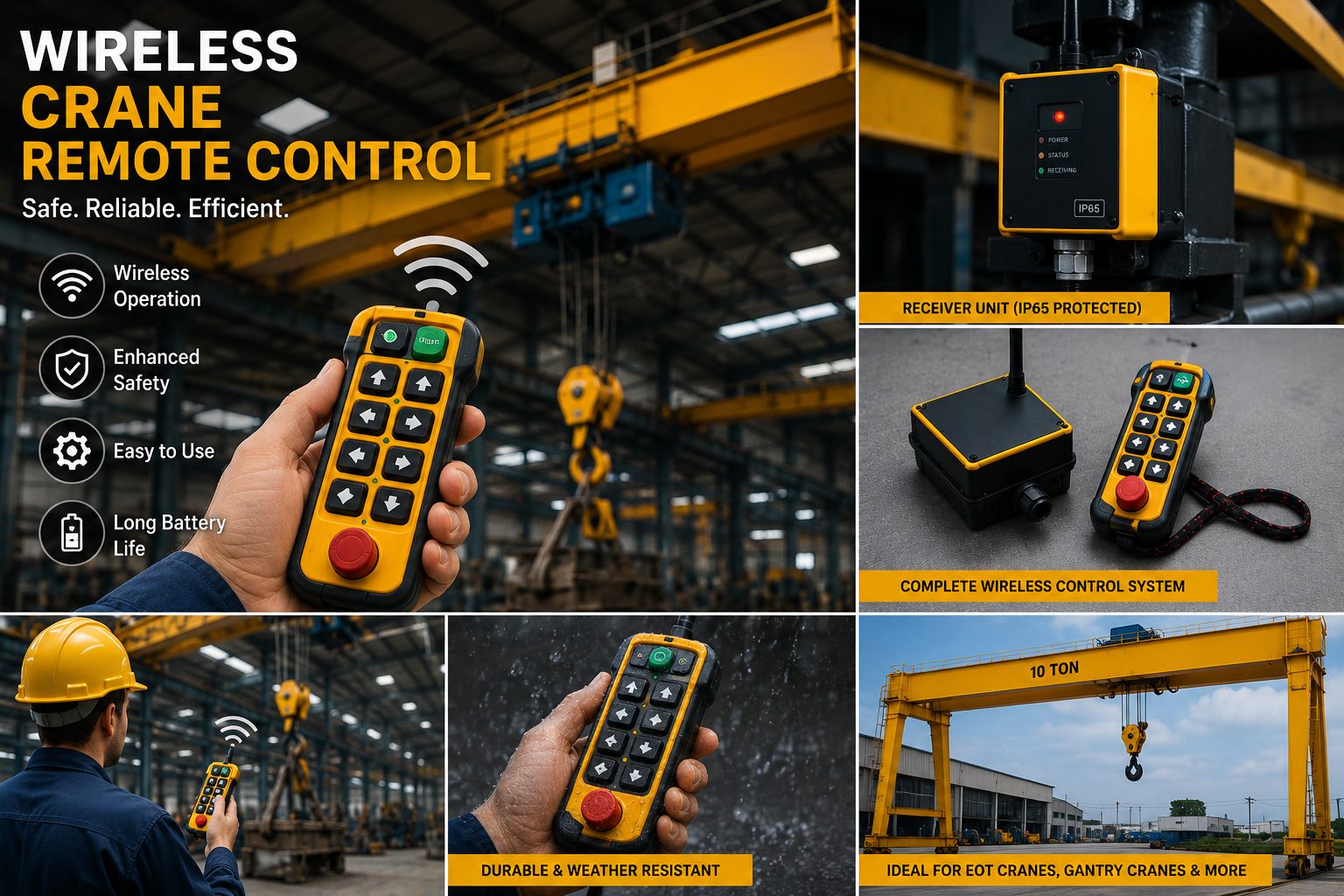
The wireless crane remote control system involves replacing the wired pendant control with the transmitter which is portable and a receiver attached to the crane itself. An operator is now able to control the movements of the crane from afar without having to remain attached to the crane.
In the past decade, the requirement for wireless systems has increased at a very fast pace in all kinds of industries in India, and at present, many Indian manufacturers of wireless crane remote control systems exist providing tough and durable systems suitable for harsh industrial environments.
Advantages of Wireless Crane Control
- Movement freedom – operators can move around freely and get into position to get the best view of the load.
- Enhanced safety because operators can keep a safe distance away from the moving load.
- No problem of cable breakage hence reduced maintenance costs
- Multiple crane operation – an operator can be able to operate several cranes through programmable remote
- Increased precision due to controls such as speed control, emergency stop, and diagnostic feedback.
- Longer service life due to lack of mechanical wear of the trailing cable
Limitations of Wireless Control
- Higher initial costs than pendant systems
- Dependence on batteries, which means frequent charging or replacement is necessary
- Potential signal interference due to presence of high electromagnetic waves, but today’s models employ frequency-hopping technique to overcome this problem
Wireless vs Pendant: A Side-by-Side Comparison
| Feature | Pendant Control | Wireless Control |
|---|---|---|
| Operator Mobility | Limited by cable length | Full mobility across the work area |
| Safety | Operator often near the load | Operator can maintain safe distance |
| Maintenance | Cable wear, connector issues | Battery maintenance, minimal wiring |
| Cost | Lower initial cost | Higher initial cost, better long-term ROI |
| Precision Control | Basic on/off functions | Variable speed, multi-function control |
| Suitability | Small workshops, light-duty cranes | Heavy industries, large spans, multi-crane setups |
Which One Should You Choose?
The right choice depends on your industry, crane size, and operational priorities.
- Even if you have a small workshop, a small crane, and are working on a tight budget, the pendant system would be beneficial to you.
- However, in case you work in steel mills, cement industries, foundry plants, ports, or large fabrication units, the wireless crane remote control system is your best bet. It increases the safety of the operator and minimizes downtime due to cable damage.
For businesses in the emerging industries of India, the advantage of dealing with a reliable crane remote control wireless manufacturing in India is that you get the machines that are suited to the Indian industrial environment, which includes fluctuating voltage, dust, humidity, and cycles of continuous use.
The Hidden Factor: Electrical Connections Matter Too
In deciding whether wireless or pendant controls will be used for a crane, an oversight made by many plant engineers is to forget about one of the smallest yet most important parts of the electrical system of a crane: the cable lug.
This is where bimetallic cable lugs come in. In most industrial applications, aluminum cables are used because of their economic benefits and lightness, while the control panels and terminal blocks in cranes are made up of copper. The use of aluminum cables in conjunction with copper terminals would be hazardous since it increases the chance of galvanic corrosion, thereby causing poor connection and overheating.
The bimetallic cable lugs offer the solution by having aluminum on one end, meant for the cable connection, while copper on the other, meant for terminal connection, brought together through friction welding. This helps ensure:
- Stable connections that prevent corrosion when joining dissimilar metals
- Lowering of electrical resistance for low generation of heat
- Increased lifespan of control panels and junction boxes of cranes
- Increased safety, particularly in continuously running industrial cranes whose operation is hindered by faulty connections
No matter whether you are putting in a wireless receiver panel or a conventional pendant control box, it would be wise to use reliable bimetallic cable lugs for every aluminium to copper connections.
There may not be a single solution, but it is a fact that the wireless crane control is gaining popularity among medium to large scale industrial operations, since it brings additional safety, operational flexibility and cost-effectiveness. While pendant control is relevant for small budget setups, India’s manufacturing sector will soon start to adopt wireless control technology due to its safety advantages and regulatory requirements.
However, it is important not to neglect the complementary equipment: good bimetallic cable lugs will make sure that whatever control system you install, you get reliable electrical installation underneath.
It makes sense when you need to install a crane control system to consider working with a company which has expertise in both wireless crane remote control and the underlying electrical installation – from control panels to termination accessories
Related Post:
Difference Between PVC, PTFE, and Fiberglass Insulated Cables
